
Breed Information Alaskan Malamute
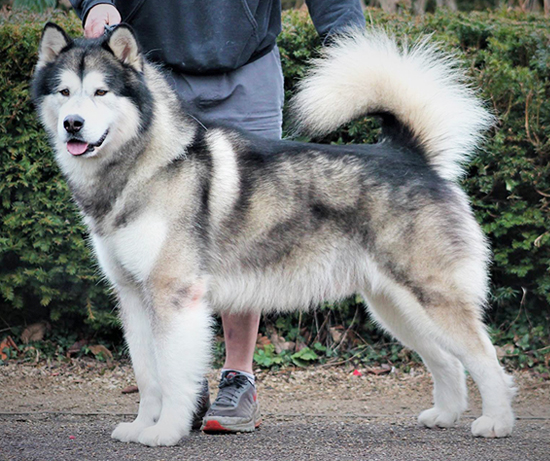
Breed Standard
General appearance – Heavily boned, powerfully built, not too compact and never appearing short on the leg.
Characteristics – A freighting sled dog capable of surviving in Arctic conditions and of pulling heavy loads at steady speeds.
Temperament – Affectionate, friendly, loyal, devoted companion but not a ‘one man’ dog, playful on invitation, generally impressive by his dignity after maturity but tends to show dominance to other dogs.
Head and skull – Head broad, powerful, not coarse, in proportion to size of dog. Skull broad between ears, gradually narrowing to eyes, moderately rounded between ears, flattening on top as it approaches eye, rounding off to moderately flat cheeks. Very slight but perceptible stop. Muzzle large in proportion to size of skull, scarcely diminishing in width or depth from stop. Nose black except in red and white dogs when it is brown. Pink streaked ‘snow nose’ acceptable.
Eyes – Brown, almond shaped, moderately large, set obliquely. Dark eyes preferred, except in red and white dogs where light eyes are permissible. Blue eyes highly undesirable.
Ears – Small in proportion to head. Triangular in shape, slightly rounded at tips, set wide apart, at back of skull. Ears forward when erect. When dog is working sometimes folded against skull.
Mouth – Upper and lower jaws broad with large teeth, with a perfect, regular and complete scissor bite, i.e. upper teeth closely overlapping lower teeth and set square to the jaws.
Neck – Strong and moderately arched.
Forequarters – Shoulders moderately sloping; forelegs heavily boned and well muscled, straight as far as pasterns which are short, strong and almost vertical viewed from side.
Body – Strong and powerfully built, chest strong and deep; back straight but not level, sloping slightly downwards from shoulder to croup. Loins well muscled, never so short as to interfere with movement. No excess weight.
Hindquarters – Hindlegs broad and powerfully muscled through thighs; stifles moderately bent, hock joints broad and strong, moderately bent and well let down. Viewed from behind, hindlegs vertical, standing and moving true, in line with movement of front legs. Legs indicate tremendous propelling power.
Feet – Large and compact, toes close, well arched, pads thick and tough, toenails short and strong. Protective growth of hair between toes.
Tail – Moderately high set, following line of spine at start then curving gently upwards. At rest may hang straight down. Well furred and carried over back when dog is working, not tightly curled to rest on back, nor short furred and carried like a fox brush, but giving appearance of a waving plume.
Gait/movement – Single tracking at trot is normal but movement not too wide or too close at any gait. Easy, tireless, rhythmic movement, produced by powerful drive from hindquarters.
Coat – Thick, coarse guard coat, not long and soft. Dense undercoat, from 2.5-5 cms (1-2 ins) in depth, oily and woolly. Coarse guard coat stands out, with thick fur around neck. Guard coat varies in length as does undercoat, but in general coat of medium length along sides of body, increasing somewhat around shoulders and neck, down back and over croup, as well as in breeching and plume.
Colour – Range is from light grey through intermediate shadings to black, or from gold through shades of red to liver, always with white on underbody, parts of legs, feet and part of mask markings. Markings either caplike or masklike on face. Combination of cap and mask not unusual. White blaze on forehead, white collar, or spot on nape permissible. Heavy mantling of unbroken colour acceptable, broken colour extending over body in spots or uneven splashings undesirable. Only solid colour permissible is all white.
Size – The preferred sizes at the shoulder are:
Dogs: 64 cms (25 ins), 39 kgs (85lbs),
Bitches: 58 cms (23 ins), 34 kgs (75lbs).
Consideration of size should not outweigh that of type, proportion, movement and any other functional attributes.
Faults – Any departure from the foregoing points should be considered a fault and the seriousness with which the fault should be regarded should be in exact proportion to its degree and its effect upon the health and welfare of the dog and on the dog’s ability to perform its traditional work.
Note – Male animals should have two apparently normal testicles fully descended into the scrotum.
Club links

History
Alaska is much more than a vast, frozen wilderness that sits at the top of the world, it is home to the magnificent Alaskan Malamute – The History The Facts & the Origins
The true beginnings of this dog will always remain a mystery. All we are privileged to know is that the earliest ancestors of all of the great northern dog breeds lived among early representatives of our own species for thousands of years. Because of the interdependent relationship they have for so long enjoyed with our species, they were probably some of the first dogs to have been domesticated
In light of so rich heritage, the Malamute is believed to have bred true for centuries, if not millennia, Hailing from the Kotzebue Sound on Alaska’s northwest coast, the Malamutes takes its name from the native Eskimos, or Inuit’s, who resided there known as the Mahlemuts. Living as they did in a land of very little vegetation and frigid temperatures, these people depended on dogs for their survival.
The Mahlemuts were nomadic and relied on their dogs not only as partners for hunting large game that was more often than not located far from home, but also, once successful in their mission, to haul that large game home over vast expanses of frozen tundra. The dogs that could for fill this duty had to be powerful and muscular with impeccable instincts, stamina, and endurance, attributes far more
Blessed as they were with these quintessential freighting dogs, the Mahlemut people did not require large teams of dogs to meet the challenges of their daily lives – yet another gift Malamutes brought to their namesake humans. The Malamutes provided more muscle per dog, and their efficient metabolisms required less fuel than one would expect from so large an animal
Beyond simply taking the name of their human family, Alaska’s Malamutes became veritable mirrors of the people with whom they shared their lives. The dogs and their humans evolved together, through the centuries taking on similar characteristics that enhanced the interdependence upon which their mutual survival relied.
Examples of this phenomenon existed in every aspect of the Mahlemut’s lives. Out of necessity, for example, the Mahlemut people were tireless workers. The greatest insult they could level against one of their dogs was to expect it to sit idle – or worse yet, to leave it at home when it came time to embark on a hunt. The Mahlemuts knew that their survival required cooperation and teamwork. Their dogs, though they could be predatory and argumentative, also understood that all must work together for the survival of both the canine and human members of the team.
The Mahlemuts were strong and independent, and so, of course were their dogs. Out on the ice, the people, in fact trusted their dogs instinct over their own, thus placing their very lives in the care of their animals. Even on a more benign plane, the people and their dogs mirrored one another, especially where children were concerned. The Mahlemuts loved children and treated them with kindness and respect. Their dogs bonded with the young of the village, too, thus spawning a legendary love for children that remains one of the breed’s most outstanding characteristics today. From work to play, to the way in which they viewed the world, the Mahlemut people could not have survived without their dogs, which not only made their people’s daily lives possible, but no doubt brightened their days, as well.
That the Mahlemut people treasured their dogs goes without saying. But while many treated their Malamutes almost as family members- better, in fact, than most arctic people treated their dogs – life was harsh for humans and dogs in those arctic settlements. Both dogs and humans had to deal with the often cruel realities of their everyday existence. When food was scare, the dogs suffered right along with their people and, at the mercy as they were of treacherous climate and terrain, when dogs misbehaved or failed to hold up their end of the work, they were rarely given a second chance to correct their ways. Nevertheless, the bond that existed between the Mahlamuts and their dogs was unique, and the esteem with which the people held their canine partners was genuine
This fact did not escape the notice of the first explores who ventured into this frozen, long unknown corner of the world in the 1800s. Upon their arrival, these adventurers invariably sang the praises of the dogs that, unlike so many other arctic dogs, were not only partners in survival, but pets as well. The dogs were subsequentlyimmortalized in the journals kept by these newcomers, who could not resist the beauty of the animals, the warmth of their personalities, and the bond they shared with their caretakers. While indeed the dogs of the frozen north, weather Malamute, Siberian Husky, or Samoyed, had to be tough, with few exceptions they were also infinitely loyal to the humans in their lives. The immortality these northern dogs found in those early writings was only the beginning.
Enter the Outsiders The trickle of explorers that came to Alaska throughout the 1800’s became a flood with the discovery of gold there in 1896. As happens, whenever that magical word “gold” is uttered, Alaska and the Yukon were inundated by people in search of wealth, many of them spurred on by legends of fist-sized nuggets lying on the beaches and by romantic tales of Jack London
London is often credited with drawing the world’s attention, not only to the adventures of life in Alaska, but also to the dogs that inhabited that frozen world. He vividly illuminated the bond between Alaska’s dogs and their men, and the world could not help but listen. What rang most true in London’s writings was the transition that was occurring at the time of the gold rush in Alaska’s canine culture.
Here lived a unique collection of dogs, that for centuries had been bred and raised to pull sleds across the frozen tundra, and to live their lives in symbiotic cohabitation with those few humans who were either born to life at the top of the world. Or were called there in search of gold, independence, or freedom from the law
While most prospectors sought the services of freighting dogs ( a calling to which the Malamute was historically suited), many began to fill their idle hours pitting their dogs against each other in weight-pulling contests ( another natural Malamute calling ), it was the racing of the dogs that drew the most enthusiastic following
While the Malamute had handily earned the title of Alaska’s premier freighting dog, the vocation of dog racing was better suited for smaller, lighter dogs that could reach and sustain greater speeds than the large Malamute was capable of. Consequently, the Malamute’s bloodlines, along with others, were used for the development of what would become the favoured racers: Siberian Husky and the Alaskan Husky.
Because of similarities in markings, the Malamute is often mistaken for the smaller, lightweight, even delicate, Siberian. With a broader head, at least double the size, and a calmer temperament than its Siberian counterpart, the Malamute has remained a better freighter than a racer.
In the Line of Duty As the twentieth century progressed, word of the Malamute’s indomitable strength, stamina, courage, and heart reached those who were organizing Admiral Richard E. Byrd’s expeditions to the South Pole. Among the dogs recruited for the two journeys to the bottom of the world were Malamutes, many of which ultimately suffered injury and illness and met cruel ends. Yet the successful exploration of this vast continent could not have been accomplished without the dogs.
The same can be said for the Malamute’s contribution to America’s efforts in World War II. Having already proven their mettle in Alaska and the South Pole, Malamutes were next recruited to serve as army dogs during the war.
Because of their natural talents, Malamutes were used to pull sleds in snow-covered areas that were inaccessible to other, more mechanical means of transportation. They were similarly used as pack animals to carry weaponry and ammunition across the frozen ground, and they served as search-and-rescue dogs, a task made possible by their ancient abilities to navigate endless fields of ice and snow. Again, many of the dogs perished in the line of duty, a sad fate to which the Malamute had long been accustomed.
Official RecognitionNo longer shrouded in Alaska’s ice and snow, after the turn of the century the reputation of the Alaskan Malamute spread south to people with more recreational goals in mind. Particularly interested in this dynamic dog were canine devotees in New England who were just beginning to embrace the new sport of sled dog racing.
In the course of their discovery, several of these people found them-selves enamored of the Malamute. The breed was not in good shape at the time. The crossbreeding of Malamutes in Alaska with such breeds as Saint Bemards and similar giants, due to the lack of enough native dogs to meet the demands of the gold hunters seeking large freighting dogs, led to a severe decline in the pure Malamute population and an all-around degeneration during the gold rush of the ancient gene pool.
This situation was rectified in time, however, by those fledgling breeders in the lower forty-eight who took it upon themselves to ensure that the Malamute would be reserved and remain pure for all time. Their success in this mission ultimately led to the official recognition of the Alaskan Malamute by the American Kennel Club in 1935.
The Modern Malamute Where legends are concerned none is more prevalent in the story of the Malamute than the belief that this dog simply must be part wolf, a legend that reached a fever pitch during the gold rush days. How else, ask those who continue to embrace this notion, could it have developed such a wolf like appearance? Yet, despite the commonly held belief that the Mahlemuts would tether a bitch to a pole in the snow so she could be bred by a wolf, countless historians, and the Mahlemut people themselves, insist the Malamute is pure domestic dog, no closer genetically than any other dog to the lupine branch of the canine family.
It is said that if you Get to know today’s Malamute, the obvious differences between it and the wolf are clear. While some similarities exist, such as that breath taking beauty, physique, a tendency to howl, and a lack of talent as a watchdog, the Malamute, unlike the wolf, has lived intimately with humans for thousands of years
Evident today in the unique affection it harbours for the human species. Today’s Malamute carries on the heritage of its predecessors. It continues to revel in the family pack, to crave human companionship, and to enjoy a special affinity for children. It continues to excel as a sled dog, thriving when the thermometers mercury drops below the freezing point, and even competing in weight-pulling competitions when the opportunity arises.
Success in a partnership with a Malamute, therefore, requires an owner who is willing to learn the Malamute’s story and to respect the significance of it. The modern Malamute must be viewed in light of the ancient Malamute, the two cannot be separated. An individual willing to make this effort, one who shares the same wild and adventurous spirit of this ancient breed, is the individual with whom the Malamute will be most comfortable and the individual who will be most content living with this magnificent animal. Very little is known about the Malhemut Inuits much of their history is shrouded in mystery and much of this mystery is still surrounding what can be only be described as one of the most magical and beautiful breeds In the world.
Today, Malamutes are seen in most areas of the world. They are tremendous companions they are shown in every state, and many foreign countries. They still work performing weight pulls, back packing, and sledding. They perform in the obedience rings provide care to elderly folks as service dogs and on occasion they have been known to sit on your lap
Malamutes are very smart, loving, devious and still the most powerful working dog in the world. All they ask for in return is love, a safe environment, and maybe, a pat on the head.
To live alongside this breed in peace and harmony is to be truly blessed.